
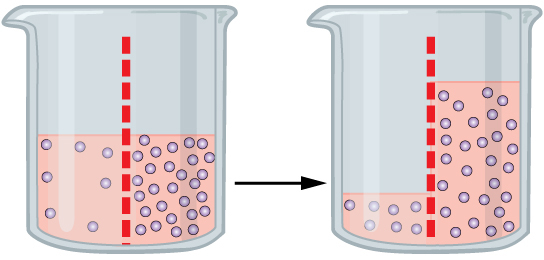
My recent post about cooking steak got a bit long. To shorten it I had to cut some things that I still think are pretty important when cooking your steak. One of the things I cut was a discussion about osmosis and how to salt your steak before cooking. Both of these issues are really important: osmosis is one of the fundamental principles of biology and will pop up time and again when discussing the science behind cooking and no one should serve a steak without putting some salt on it before it is cooked. So I thought I’d post that discussion in this shorter post.
One of things you really want when cooking a steak is to get a good sear on the outside of the steak. To get this sear, caused by Maillard reactions at high temperatures, you want to get your steak as dry as possible. Moisture interferes with searing as energy from the pan or grill will go into evaporating the moisture and not into the Maillard reactions.
Another thing you want to do is put some salt on your steak, salt is a flavour enhancer so your steak will taste better with salt. But salt can also help, or hinder, the development of good sear so it is important to know when you should add salt to your steak. This is where you need to know something about osmosis.
Osmosis, a very important concept in biology, is the movement of water from a region of lower solute concentration to a region of higher solute concentration through a semi-permeable membrane. A solute just means something dissolved in the water, and salt is one of the more common solutes you’ll come across in cooking. A semi-permeable membrane is something that lets some molecules through, like water, but not others. The cells that make up your steak have walls that are semi-permeable membranes (actually all cells have this characteristic) so when you put salt on your steak you are creating the osmotic conditions for the movement of water out of the steak onto it’s surface because there is more salt on the outside of the steak than the inside.
You can see osmosis at work if you have a look at the surface of your steak after adding salt. You should see little beads of water that have formed all over the surface of the steak. On the face of it this is a bad thing as we want a dry surface for the Maillard reactions. But if you keep watching the water will eventually move back into the cells leaving the steak surface dryer than it ever was. The reason for this is that after a while the salt starts working its way into the steak and denaturing the steak proteins. This increases the water retention ability of the steak and it also changes the osmotic potential across the cell wall causing water to be drawn back into the steak.
In his book The Food Lab, J. Kenji López-Alt looks at this process in detail. He found that after adding salt to a steak water will start moving onto the surface within three or four minutes. After about ten to fifteen minutes the salt starts moving into the steak and by about fifty minutes all the water will have been drawn back into the steak.
So what does this mean for our steak cookery? If you want a good sear on your steak, either salt immediately before cooking, before water has a chance to move out of the steak, or salt at least fifty minutes before cooking. If you cook your steak any time in between you will have moisture on your steak that will interfere with the Maillard reactions. Fifty minutes isn’t the maximum by the way. You could salt your steak and leave it in the fridge for a few hours. The steak will be nice and dry and the salt would have had much time to move through the entire steak, seasoning as it goes. This will give you the best chance of getting a good sear on a tasty well-seasoned steak.

 The Science of Food

Leave a reply to Soaking Zucchini Before Cooking: A Complete Guide Cancel reply