
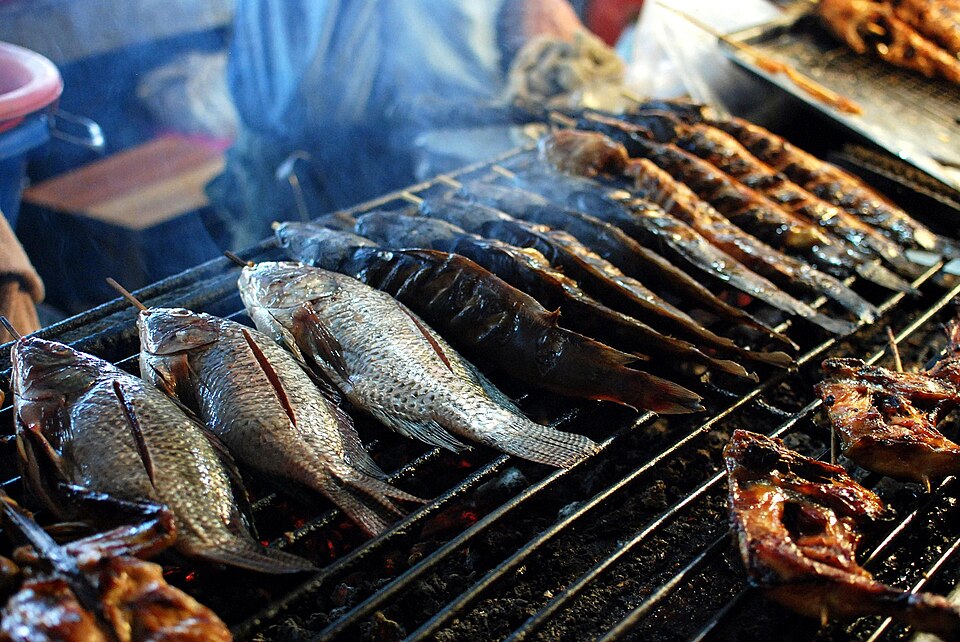
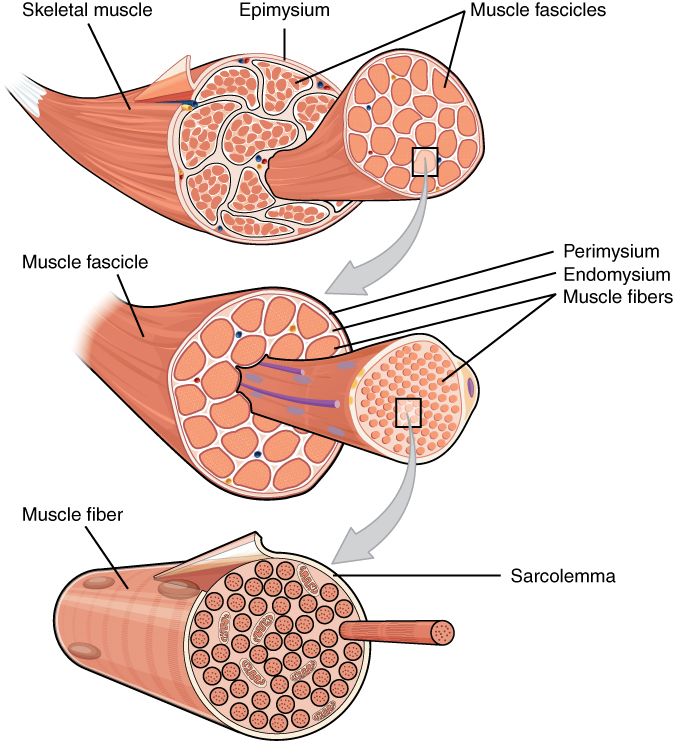
In some of the earliest posts I wrote for this blog I discussed how cooking meat is all about anatomy. Understanding the anatomy of muscles, and how particular muscles are used by the animal, helps you understand which muscles are tender and which are tough. The toughest meat is from the muscles that did the most work when the animal was alive. They have larger muscle fibres with more collagenous connective tissue. Muscles that saw the least work are the opposite: smaller muscle fibres and less connective tissue. Where a piece of meat sits on this toughness scale dictates how we cook it. An eye fillet is a quick thrust and parry to get a good sear on the outside without overcooking the rest. A brisket is a long battle with connective tissue and collagen. And always cut against the grain.
We shouldn’t put the horse before the carriage though. Animals don’t evolve so that their anatomy will give us an interesting cooking challenge. The anatomy of any animal, including us, is a response to the environment they live in and, so far, I have only really considered how to cook meat from animals that live on the land. Terrestrial animals come in all sorts of shapes and sizes but one thing we all have in common is a constant battle with gravity. All animals that live on the land have been obliged to evolve ways to strengthen their body to avoid being flattened under the crushing force of gravity.
In response to this challenge insects have evolved an exoskeleton but if you want to grow to any reasonable size under the full force of gravity you need an internal skeleton, and things like legs. Giant ants, though fun in a Hollywood movie, would be a pitiable creature in real life; unable to breathe and immobile, flattened by the force of gravity acting on its mass. Large terrestrial animals need a strong internal skeleton. They also need long, strong muscles that are firmly anchored to this skeleton. This gives land animals the strength to counter gravity, so that we can move around, and the range of motion that we need to get things done. This is why we need to consider muscle fibres, connective tissue and collagen when we cook meat. It’s no accident that the toughest cut of meat on a cow, the brisket, is the muscle group that does the most work when a cow is just standing chewing its cud. The cow looks relaxed but the brisket is busy defying gravity.

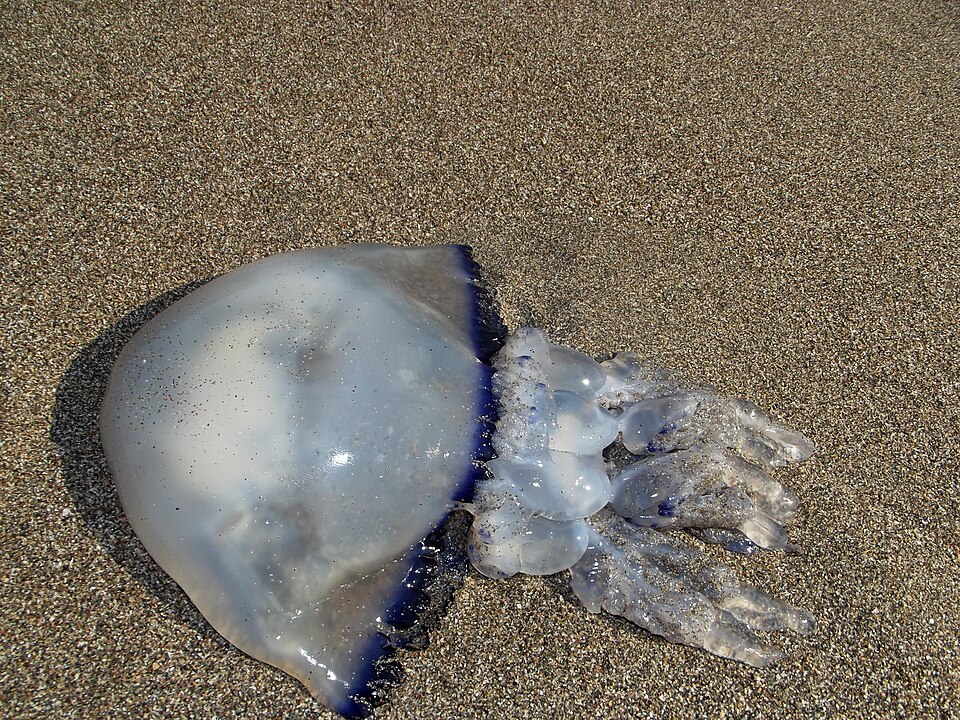
Now lets consider fish. The most obvious thing about fish is that they live in water. The thing about water, or any fluid, is that it exerts an upward force on anything in it. This is called buoyancy. This is very useful for aquatic animals because the upward force of buoyancy protects them from gravity. Anyone who has walked down a beach knows that jellyfish do not do well on land, yet they survive quite well in the ocean. This is because aquatic animals don’t need to worry about gravity. They don’t need a strong skeleton reinforced with large amounts of calcium, nor do they need muscles that are substantially reinforced with connective tissue. When it comes to fish, they also don’t need a wide range of movement. The lifestyle that fish have adapted means all they really do is swim. Sometimes they swim quickly and sometimes the swim slowly. But it’s mostly swimming, most of the time.
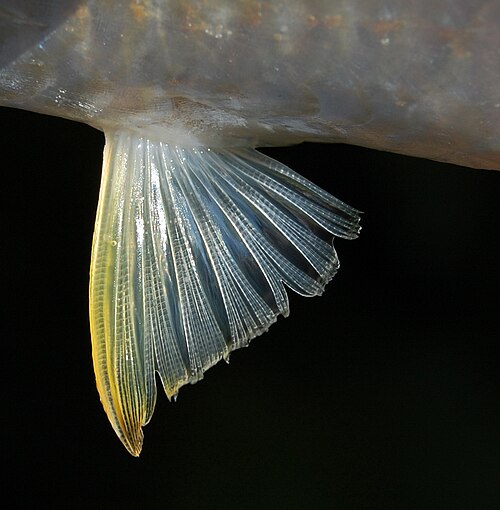
Now I keep saying fish but there are a lot of different fish in the world. About 30,000 different species of fish swim around in the oceans and waterways of our world. This could make it difficult to generalise about fish, but things are made easier by the fact that 99% of these fish belong to a single class called the Actinopterygii. In English this means “ray-finned” and they are so named because these fish all have skin covered fins supported by bony spines1 that radiate from a central connection to the internal skeleton2. As they make up most of the fish species so the ray-finned fish are also the majority of the fish that we eat3. Fish like salmon, tuna, trout and cod are all ray-finned fish as well as things like eels and monkfish that, at first glance, don’t seem to share too many similarities with other fish.
From an eating perspective, one of the most important anatomical features of many of the ray-finned fish are short skeletal blocks, called myotomes. All chordates have myotomes (which means we also have them) but many ray-finned fish have evolved very short myotomes organised into ‘V’ or ‘W’ shaped chevrons. These short blocks of muscle are held together by thin sheets of connective tissue that connect the myotomes to the skeleton of the fish. Sequential contraction of the myotome blocks create a undulatory, side-to-side, motion that propels the fish through the water.
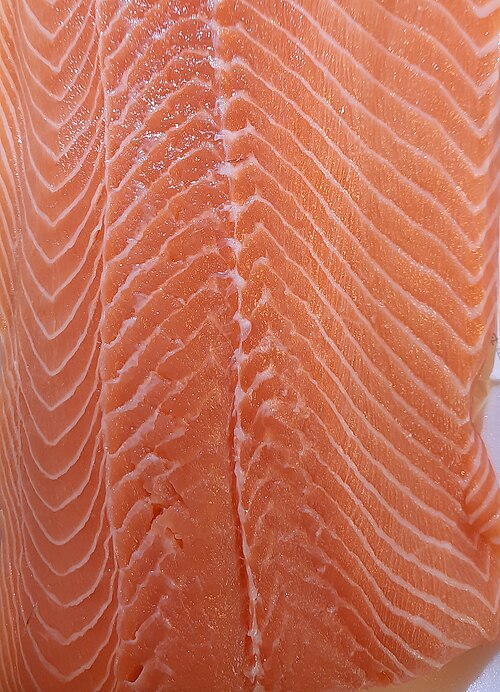
This musculature is good news for the fish. It makes them very efficient swimmers. It’s also good news for anyone who enjoys eating fish. The short myotomes make for short muscle fibres which means fish flesh is tender; we don’t need to chew through long muscle fibres. When preparing meat from land animals we try to carve across the muscle fibres to shorten them before serving. Fish, essentially, save us the trouble by carving themselves against the grain for us. We get the benefit of this whenever we eat the tender flaky segments of a well cooked fish.
It’s not just myotomes though. Fish still have plenty of connective tissue and if it was the same connective tissue we find in land animals we’d have a problem. What saves us is that fish don’t need a lot of structural support for their muscles, no gravity remember. So fish connective tissue tends to be much lower in collagen than land animals like beef. Fish collagen is also a lot less thermally stable than something like beef collagen. We’ve seen before that beef collagen breaks down at around 70C but fish collagen can begin to breakdown at around 40-50C. Collagen from cold-water fish can breakdown at even lower temperatures; salmon collagen, for example, starts breaking down at temperatures as low as 19C.
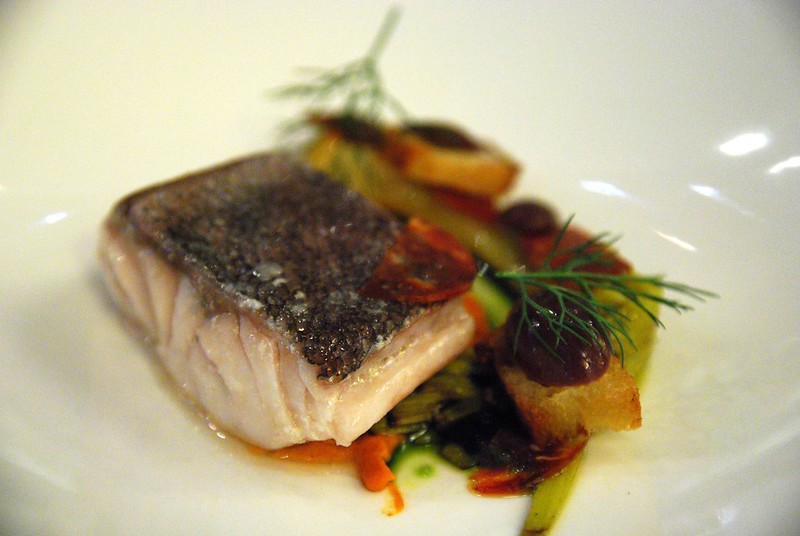
When you put these things together you can see how a well cooked fish should be slightly opaque, as the proteins in the muscle fibres coagulate, and easily separated into segments as the connective tissue between the myotomes breaks down. When considered this way it would seem that cooking fish is not that different from cooking a tenderloin or some other tender cut of meat and in some ways that is true. In both cases, collagen is not much of a problem and the job is really to get the muscle proteins coagulated and not dry out the flesh. But there are some wrinkles we need to be aware of when it comes to fish cookery.
Firstly, fish flesh is less dense than meat. It has a lot less collagen in its connective tissue and a higher water content than land animals. This means that heat will travel faster through the fish than it would in a steak, particularly when water is converted to steam. Separation of the myotomes as the delicate connective tissue breaks down also helps the spread of heat through the fish. This means, even more so than a steak, the difference between a well-cooked and an over-cooked fillet can be a matter of seconds. In my experience, it can take a bit of practise before you get start getting this right.
Complicating things, different fish have different characteristics that affect their cooking time. Dense fish like tuna and swordfish will cook a lot faster than cod and bluefish. Fat is an insulator and it will slow down the transfer of heat, so fatty fish like mackerel, salmon and trout will cook more slowly than cod, tilapia and whiting. Keeping in mind that we are talking about fish, so by longer I mean seconds or minutes. There is no slow cooking in fish cookery.
Apart from heat transference, fish also cook quicker because their proteins coagulate at a lower temperature than we are used to in meat from land animals. We are mostly concerned with myosin and actin when looking at muscle proteins. With beef you are looking at a well done steak if the temperature has gotten to 70C, and a medium steak at around 60C. As we’ve seen with collagen though, fish proteins tend to be more sensitive to heat than terrestrial animals. Fish myosin starts coagulating between 40-50C while fish actin is more stable, coagulating between 70-74C. Given this, fish flesh is normally done at a temperature a good ten degrees lower than meat. A rule of thumb is that fish cook to medium at an internal temperature of 50C and well done, if not dry, at 60C.
We can get our fish up to the appropriate temperature in all the same ways that we do with meat: grilling, baking, braising and frying. Given the speed at which fish cooks, it can be tempting to go slowly so as to have some control and more time to judge if the fish is done. This works well for many fish but not all. Some fish have high levels of proteases (enzymes that breakdown proteins) that are only inactivated at temperatures between 50-70C. If you are going slowly and spend too much time between 50C and 65C you can end up with a very unpleasant mushy texture as the proteolytic enzymes break down all the proteins. For fish with this tendency, fish like swordfish, whiting, tuna, mackerel and salmon, it’s best to cook them quickly over a moderately high heat4.
All this is just a scratch map for cooking fish. The barest outline. But before I finish there are a few other things worth keeping in mind when dealing with fish. Firstly, just the same as land animals fish possess fast twitch and slow twitch muscles. Fish like to cruise around but sometimes they need to move quickly and they tend to use different types of muscles for those activities. Also the same as terrestrial animals, slow twitch muscles have a higher amount of myoglobin in them for storing oxygen that can fuel steady movement. Fast twitch muscles, built for explosive movement over a short period of time, respire anaerobically so don’t have stores of myoglobin (I go into depth on this in a previous post).
Myoglobin gives muscles a darker, redder tint so fish will have dark and white meat. In general, the dark, slow twitch muscle goes along the sides of the fish, along the lateral line and the backbone. You can often see this as a bright red line along a fillet, under the skin or near the backbone. Though it is muscle tissue you might hear it referred to as the bloodline. This tissue tends to more vascularised and fatty and can vary in flavour from the white meat so some chefs remove it, but it is perfectly safe to eat.
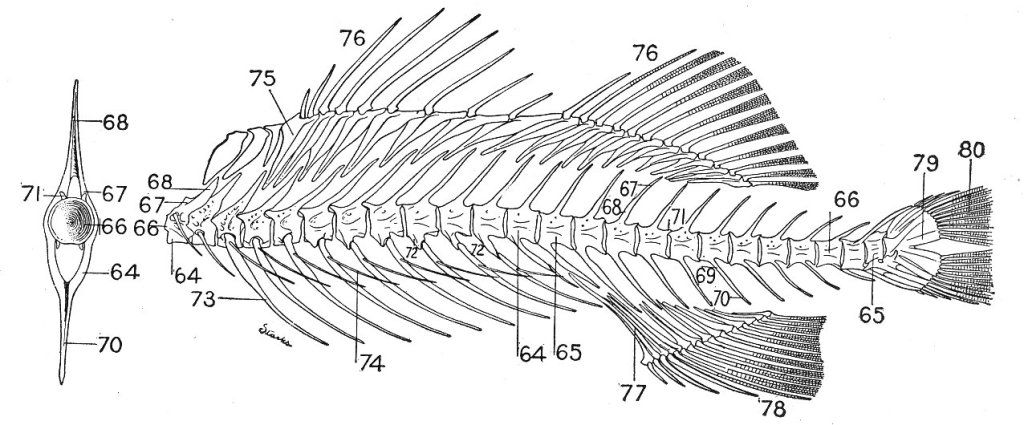
When prepping a fillet, or eating a whole fish, it’s good to remove, or look out for when eating, the pin bones. These are bones that extend from the main skeleton into the connective tissue of the flesh (you can see them in the figure above labelled as 74). They tend to be sheared off when filleting a fish and remain stuck in the fillet. Though you can leave them there and let the diners look out for themselves, it is probably good manners to have a go at removing them before cooking. This is best done using pliers or tweezers and I’ve put a video explaining how to do it below. It is typically the “round” fish that have pin bones, so you have to look for them in fish like salmon, trout, herring, perch, and carp. Flat fish, like plaice, sole or, if you in the Indo-Pacific region, flathead, don’t have pin bones.
On the topic of bones, fish bones are real calcified bones, just like ours. But, whereas our bones are designed for strength when fighting gravity fish bones are designed for buoyancy. This means they are less dense and less calcified than ours and can be quite easily dissolved in a short boil. This is why the bones, even the vertebrae, you find in canned salmon can be easily mushed up and eaten. This also means that you don’t want to cook a fish stock for longer than an hour or so. If you go longer too much calcium will dissolve out of the bones and make the stock cloudy and give a chalky flavour.
Finally, a quick word on food safety. In general the risks of eating fish are pretty much the same as eating any type of meat. I’ve covered some parasites that you’ll find in fish and bacteria is, just like in meat, an important consideration. Health authorities, like the FDA and others, suggest cooking fish meat to an internal temperature of at least 62C. This will give you slightly overdone fish but with a lower risk of infection by parasites or bacteria.
One difference between fish and meat is that fish spoils quicker, especially if kept in a refrigerator that normally runs at 4-5C. Fish, especially cold water fish like salmon, mackerel, sardines, trout, herring, and cod, have a biochemistry that is adapted to cold conditions. We’ve already seen that most of the proteins in a fish are more sensitive to hot conditions but the reverse is also true. Fish enzymes can often be active at temperatures you’ll find in the typical refrigerator. This means that fish can spoil quicker in the fridge than if they are kept on ice at around 0C.
The same goes for bacteria that live on these fish, they are also adapted to cold temperatures and can also be active in the refrigerator. A good rule of thumb is that a fish will spoil twice as fast refrigerated as iced. Also keep in mind that by the time you have bought the fish it will have potentially already spent a considerable amount of time on ice, reducing the time you have to keep it iced and retain quality.
This is already a long post and I have barely scratched the surface of how to cook fish but it’s a huge topic and one I’ll need to revisit in future posts. In my experience learning how to cook fish was a daunting prospect. A steak seems so much more forgiving, especially on the grill, it doesn’t cook unexpectedly quickly, it doesn’t have skin that sticks to things, it doesn’t have bones sticking out in unusual places and it doesn’t threaten to fall apart at the slightest touch when done. Nonetheless it is a skill well worth learning. Fish can be a cheap and impressive way to feed a crowd and, above all else, they just taste good. Hopefully, knowing a little bit of the science behind fish helps us all be a little bit better at cooking them.
Footnotes
- These spines are real bone, just like ours which makes all ray-finned fish also bony fish. Though not all bony fish are ray-finned. It also distinguishes them from things like sharks that use cartilage to construct their entire skeletons. ↩︎
- Other types of fish are those called “lobe finned” fish. The fins of these fish have a structure more similar to our limbs with a muscular limb bud within their fins. These fish are of course the direct ancestor of tetrapods, like humans, that used their limb buds to transition from the oceans to the land some 350 million years ago. ↩︎
- Some of the non-Actinopterygii fish that humans consume are lampreys, sharks, rays, skates and hagfish. Apart from shark, which is called ‘flake’ in Australia, I have not had a lot of experience eating most of the fish on this list. ↩︎
- For an exhaustive study on the effect of heat on rainbow trout see here. ↩︎


 The Science of Food


Leave a reply to Gary Cancel reply