
If you’ve ever been in a coffee shop in the 21st century you’re familiar with the scene; people on laptops, headphones on interacting online while sipping their latte, cappuccino or piccolo. I’m certainly not condemning this behaviour, and have done the same many times, but what strikes me is a weird sense of continuity, a sense that despite our technological advancements we are still behaving much the same way as our ancestors. If you go back a couple of hundred years, particularly so during the Enlightenment, coffee shops were the place where people could come together socialise, play games, access books and newspapers, discuss the news of the day and sometimes foment social disruption. To my thinking coffee shops are still providing a forum for this type of human interaction because, while the arguing is happening online, coffee is still the fuel driving scrappy discourse and the human desire to contradict their fellow man or woman.
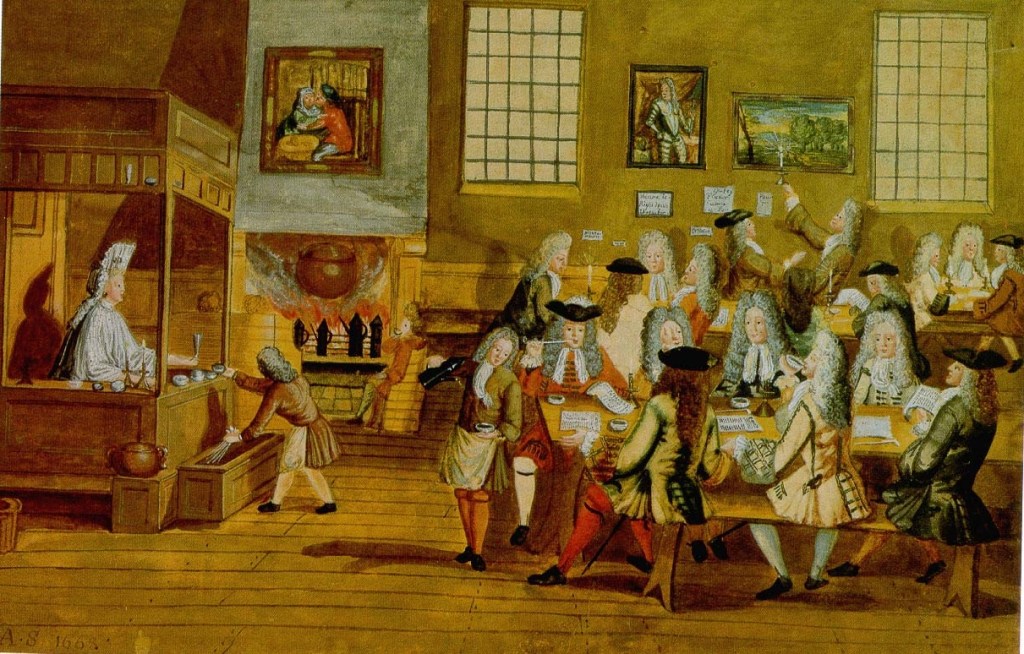
Although the first coffeehouse is thought to have been established in the Ottoman empire around 1475, surprisingly, given the English penchant for tea, one of the richest flowerings of cafe culture was in England where, by 1675, there were more than 3,000 coffee shops. Back then coffeehouses were often regarded with suspicion as hotbeds of sedition and free speech and that they were open to all, regardless of social status, only made them more suspect to the ruling elite. At least three English monarchs were very concerned with the goings on in coffee houses, Charles II actually tried to shut them all down at one point, as the people who frequented them were liable to “spread false and seditious reports”. Charles was argued down eventually, the coffeehouses were already too important to London society. One measure of this importance are the institutions that the coffeehouses fostered: Lloyd’s of London, the London Stock Exchange and both Sotheby’s and Christie’s auction houses all began in coffeehouses at this time.
It is maybe not that much of a surprise that coffee houses had a reputation for fomenting rebellion and sedition because as we all know coffee is a powerful stimulant and it would have done nothing to quell arguments or dampen the revolutionary zeal of those knocking back black coffee as they argued and plotted. Not that these early caffeine addicts would have been oblivious to coffees stimulant properties, from the very beginning humans were onto coffee as something that could provide a bit of a kick when needed. It’s generally accepted, without much evidence it must be said, that coffee drinking began in Ethiopia. The local legend there is that a goat herder noticed that his goats got frisky after eating some coffee berries and after trying them himself he told the local monks and we never looked back, soon coffee had spread through the middle east, into Europe and now the world. This legend is almost surely apocryphal but it makes it pretty clear that, despite the amount of coffee connoisseurship you encounter, the focus has always been as much on coffee’s ability to give us a bit of a lift as it has been on the flavour.
Just about everyone knows that the stimulant effect of coffee is a result of the caffeine that is found in the berries of coffee plants. Tea actually has more caffeine (2-3% by weight versus 1-2% for coffee beans) but the different brewing processes results in a cup of coffee generally having more caffeine than a cup of tea. Caffeine is a small molecule of the methylxanthine class, which is the technical way of saying it is a purine base, containing a double ring structure, with some extra methyl groups (the methyl groups can be seen in the figure below as CH3 ). In its pure form caffeine is a white, bitter powder and imbibing between 5-10 grams of pure caffeine will most likely result in your death from ventricular fibrillation (which is when the ventricles of the heart quiver, or fibrillate, instead of pumping blood). In more realistic dosages caffeine results in the pleasant buzz or perk up we get from our morning cup.

Caffeine is a slightly unusual drug in that it is has a remarkable high oral bioavailability. Bioavailability is the way that we refer to the proportion of a drug that makes into the systemic blood system after administration. By definition if you inject a drug into the blood stream it is 100% bioavailable, all of the drug makes it into the blood stream. But if you administer a drug another way, orally for example, the drug needs to be absorbed through the gut and then pass through the liver, the proportion of the drug that survives that process is called it’s bioavailability, or oral bioavailability in this case. The liver is the organ that is responsible for processing many of our nutrients into less toxic or more useful chemicals and as blood flows directly from the gut to our liver before it enters the general circulatory system, the liver can often destroy drugs before they reach the part of the body the drug is targeting, a process that is referred to as ‘first pass metabolism’ or the ‘first pass effect’.

Apart from the liver, the intestinal tract itself is a pretty difficult place to be in if you are a drug as you need to deal with high acidity and, if you are a protein drug, a bunch of enzymes, called proteases, are there to break you up into your constituent amino acids that are easier for the body to absorb through the gut wall. This is why we need to inject some drugs, many of them have no chance of getting through the gut and into the blood stream. Insulin, for example, is the classic case of drug that needs to be injected because of it’s very low oral bioavailability. Caffeine is slightly unusual as it has virtually 100% oral bioavailability and almost no caffeine is broken down during first pass metabolism. So if you drink a cup of coffee 100% of the caffeine will get into your blood stream and this is part of the reason why coffee is such an effective stimulant.
Another part of the reason why caffeine is so effective is that it is amphiphilic, it has a hydropobic and a hydrophillic part (see the second emulsions post if you want to refresh your memory about amphiphilic molecules) and this, when combined with it’s small size, means that caffeine is able to cross the blood brain barrier and interact with the cells in your brain. The blood brain barrier is an important concept in pharmacology and it refers to the way that tissue and blood vessels are arranged in the brain so as to limit the passage of molecules from the blood into the brain. The blood brain barrier protects the brain by allowing certain molecules, water and oxygen for example, to cross the barrier but preventing the passage of other potentially harmful molecules.

Apart from simple substances like water and oxygen, only certain molecules are able to cross the blood brain barrier, generally lipid soluble or amphiphilic molecules, so if you are designing a drug that needs to get into the brain, say for a brain tumour, then the drug will need to be able to cross the blood brain barrier. A big part of pharmacokinetics and rational drug design is trying to improve the movement of drugs across this barrier by altering their chemistry while preserving their desired effects. The mechanics of how molecules are able to cross the blood brain barrier aren’t fully understood and it is a pretty complicated topic but if you want to go down that rabbit hole you can start here, the important thing for us is that when we drink a cup of coffee all the caffeine gets into our blood stream and a whole bunch of that caffeine gets into our brains.
Once in our brain caffeine is able to interfere with the way the human body regulates cycles of sleep and wakefulness. You’ve probably heard of the circadian rhythm which is the schedule regular changes that occur in your body over a 24 hour cycle. Light is the number one influencer of the circadian rhythm, hormones such as melatonin and cortisol, are sensitive to light in that light inhibits melatonin production (the ‘sleep’ hormone) and increases the production of cortisol (the ‘wake up’ hormone). Over the course of a day the circadian rhythm is the ebb and flow of hormones such as melatonin and cortisol the relative levels of which will influence just how sleepy we feel.
But for the last forty years or so sleep researchers have actually thought about sleep and wakefulness as the result of two processes working in tandem in the body. One being the circadian rhythm, called the c-process in this context, and the other being the s-process. In simple terms the s-process represents a ‘pressure’ to sleep, during the day as you go about your business the levels of a molecule called adenosine begin to rise in your body and the higher the level of adenosine the sleepier you feel. When you fall asleep adenosine gets recycled, it’s levels drop and the sleep ‘pressure’ decreases until, with the help of cortisol from the circadian rhythm, you wake up.

The c-process and the s-process thus work together to make you sleepy at appropriate times of the day, in sync with the rising and falling of the sun. You might have had first hand experience of this, if you stay up all night, which means a strong pressure to sleep from all that adenosine in your system, you still tend to get a bit of a ‘bump’ around sunrise that could be when cortisol, mediated by the circadian rhythm, kicks in (something I have experienced during my misspent youth and a lifetime of insomnia).
Adenosine is able to cause sleep pressure by influencing the production of excitory neurotransmitters in the brain, two of the most important being dopamine and glutamate. Cells are able to signal what I guess you could call fatigue by releasing adensoine which binds to receptors on the surface of other cells causing them to stop producing dopamine and glutamate, lowering the general activity of neurons in your brain. We’ve also come across adenosine before, in the post on beer I talked a bit about fermentation as a form of metabolism and about ATP which is the energy ‘currency’ of the cell. Well the ‘A’ in ATP is adenosine and adenosine is a byproduct of cellular metabolism so in our bodies the pressure to sleep is intimately tied to how much energy consumption is going on, the more you, and your cells, are doing the more tired you will feel.
So how does caffeine get involved in all this? In my post about chillies I talked a lot about capsaicin and cell membrane receptors and caffeine is just like capsaicin in that caffeine interacts with receptors on the surface of cells but caffeine doesn’t interact with receptors that make you think you are burning but with receptors in the brain that happen to be the same receptors that adenosine binds to as part of the sleep cycle s-process. But, unlike capsaicin, caffeine doesn’t activate the receptor it inactivates it, it is an antagonist of the receptor (an agonist binds to a receptor and activates it an antagonist binds but doesn’t activate).
When adenosine binds to an adenosine receptor in the brain dopamine and glutamate levels will fall, but if you drink coffee caffeine will bind to the receptor instead of adenosine but will not activate it like adenosine would have. By blocking adenosine from binding and activating the receptor, caffeine ensures that dopamine and glutamate will continue to be made and, as far as your brain is concerned, there is no more sleep pressure regardless of the actual levels of adenosine. The more coffee you drink the more caffeine there will be in your brain competing with adenosine and keeping you awake. I’ve greatly simplified all this, but in broad strokes this is exactly why coffee wakes you up or prevents you from getting to sleep, it negates the effects of adenosine in the s-process part of the sleep cycle (as I said I’ve greatly simplified all this but if you want to do a deep dive you can start here).
Now we’ve all overdosed on coffee or had too many Red Bulls and it seems like there is a lot more going on with caffeine and there is. Firstly, one of the ways I’m simplifying the science here is by talking about adenosine receptors as if there is only one type and that they only exist in the brain. Human biology is much more complicated than that, receptors are typically grouped into classes based on the agonist that was originally involved in their discovery, so adenosine binding receptors are called adenosine receptors and receptors that bind nicotine are called nicotinic receptors because they were originally discovered as nicotine binding receptors (even though the primary agonist in the body is acetylcholine). Each class of receptor often has different subtypes, sometimes many different subtypes, and the receptor subtypes are distributed throughout your body and can mediate different processes. So although adenosine receptors are found in the brain, they are also found in different parts of the body.
There are four different subtypes of adenosine receptors in the human body (A1, A2A, A2B and A3) and caffeine antagonises all four types to a greater or lesser degree. The A1 and A2A receptors are found in the brain, as we’ve seen, but they are also found in the heart where they, amongst other things, affect heart rate. Because of this adenosine is used to treat some types of tachycardia (rapid heart beat) because adenosine, by interacting with A1 and A2A receptors, is able to slow the heart rate (as well as having sedative effects because of it’s activities in the brain as we saw above). Just like what occurs in the brain, caffeine as an antagonist of adenosine receptors will have the opposite effect, any regulation of heart rate occurring due to adenosine levels will be reduced by caffeine competing for adenosine receptor binding spots and your heart rate will increase, an effect that we can all attest to if we’ve had too much coffee.
Caffeine has a bewildering array of other affects on the human body, and I’ve already go on way too long but if you are interested there is a pretty good scientific review of the topic here. Coffee isn’t the only source of caffeine we have available and the above discussion is valid for any source of caffeine. Tea and soda are the other common sources of caffeine but you can get giant doses of caffeine from energy drinks. Guarana for instance is the name of a plant not a chemical and that plant contains twice the amount of caffeine that coffee beans do and it is the high levels of caffeine in energy drinks that give them their effect, not guarana. I hope to write posts on most of these different sources of caffeine, and more on coffee as well, but getting a handle on the effects of caffeine is a good place to start looking at this most used drug in human society.


 The Science of Food

Leave a reply to Jason Mulvenna Cancel reply