
We obey the laws of physics in this house, Lisa.
TL;DR: The Science of Food Production
We sometimes forget that physics applies to us as well as everyone else:
- The Physics Bottleneck: All food energy originates from the sun, but only plants can efficiently capture and convert it into biomass via photosynthesis.
- The 10% Rule: As energy moves up the trophic levels (from plants to herbivores to carnivores), roughly 90% is lost, leaving only ~10% for the next level up.
- Why We Farm Herbivores: Farming carnivores (like coyotes) is inefficient because of the 10% biomass rule; humans naturally lean toward eating primary producers and herbivores.
- Modern Illusions: Ecological limits, crop failures, and supply chain shocks remind us we are still bound by physics.
Got a question you want answered in a hurry? Checkout the FAQ.
Ernest Rutherford, famous physicist and 1st Baron Rutherford of Nelson, allegedly divided all the sciences into physics and stamp collecting.
As a chemist I try not to take this comment too much to heart. Rutherford was from New Zealand after all. I’d also note that he received his Nobel Prize in chemistry, not physics. So, who’s laughing now Ernest?
But I digress, and as much as I hate to admit it, I see his point.
Everything, when you delve deep enough, is bounded by the laws of physics. A fact that we tend to forget, caught up in our technological hubris as we are.
A very good example of this are our food systems.
Our food production systems are based on some very shaky physics indeed. Yet our response is normally to lie back and think of our next steak dinner.
We could talk about the fact that one joule of energy on our plate took ten joules of energy to get there; most organisms need to expend less energy gathering their food than they get from eating it. Not us though. We have fossil fuels.
But rather than that, today I want to have a look at the basic fundamentals that govern the flow of energy through our ecosystems and what that means for our future.
Understanding Trophic Levels and the Energy Pyramid
When we are talking about food, apart from some exceptionally weird geothermal ecosystems found deep in the ocean, all our energy comes from the sun.
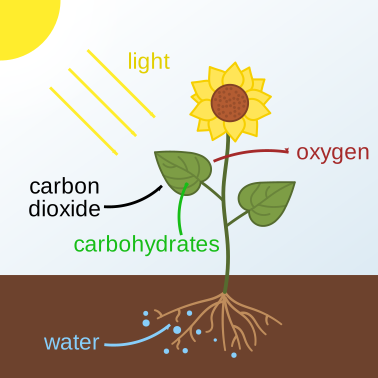
An unavoidable bottleneck in the flow of energy from the sun to our stomachs is that plants are the only organisms that can convert sunlight to biomass.
We cannot photosynthesise nor can any of the animals we rely on for food. Only plants can photosynthesise and without the efforts of our botanical friends all that energy we receive from the sun would just be heating rocks.
The Energy Pyramid
So, all life on Earth relies on plants ability to capture the suns energy and turn it into biomass. To model this ecologists use the idea of an energy pyramid.
Everyone has probably seen the energy pyramid; plants are at the bottom level, they are the primary producers making biomass from sunlight.
The next level up are the primary consumers that eat the primary producers. They’re the ones who convert plant biomass into herbivore biomass. You know, cows, sheep, goats and llamas.
Subsequent levels contain secondary consumers who eat the primary consumers and turn herbivore biomass into carnivore biomass, then tertiary consumers who eat secondary consumers and so on.
The levels go all the way up till you get to the apex predators like eagles or tigers who are no one’s food (until they die anyway).

Why the Energy Pyramid is a Pyramid
As you go up the energy pyramid the levels become smaller in width. This isn’t a graphic design decision. This represents the fact that there are fewer organisms in each level and it is a direct consequence of the way energy flows up through the pyramid.
Plants that, apart from a few edge cases, don’t eat other organisms absorb energy from the sun and convert between 1 and 5% of that energy into plant biomass.
From there on only about 10% of the energy in any trophic level makes its way up to the next level as biomass.
Animals can eat plants or each other, but 90% of the energy in the biomass they consume gets used by the organisms to move themselves around, track down more food, find a mate or produce PowerPoint presentations.
A lot of it is also just lost as heat or is not digested and gets excreted (like fibre in human diets).
The consequence of this remorseless physics is what I alluded to above. Each trophic level can support fewer organisms than those below it.
If, for examples sake, there is 100 kg of plant biomass in your ecosystem you can only ever get 10 kg of herbivore biomass and 1kg of secondary consumer biomass.
In any ecosystem there will always be fewer apex predators, like eagles, and more herbivores, like rabbits.
| Trophic Level | Ecological Role | Example Organisms | Energy Retained (~%) |
| Primary Producers | Converts sunlight into biomass | Plants, Phytoplankton | 100% (Baseline) |
| Primary Consumers | Herbivores eating plants | Mice, Cows, Caterpillars | ~10% |
| Secondary Consumers | Carnivores eating herbivores | Coyotes, Small fish | ~1% |
| Apex Predators | Top of the food chain, no natural predators | Eagles, Tigers, Orcas | ~0.1% |
Where Do Humans Sit on the Food Chain?
But, you may say, what about humans? We’re apex predators, aren’t we, why are there so many humans running around?
The explanation for this is that we aren’t really apex predators (though there is some debate about this).
Also, humans, like other organisms, are capable of occupying multiple trophic layers at once.
The energy pyramid is not rigid thing and humans in hunter/gatherer mode, for example, are part primary consumer (the gathering) and part secondary, tertiary or apex consumer (the hunting). Access to multiple levels means that you have more energy available.
But these aren’t the real answers, the real answer to our success is agriculture.

Agriculture Changed Everything
In prehistoric times, our numbers, like every other organism, were limited by the energy available to the trophic levels we inhabited.
Agriculture changed all that.
Firstly, we moved down the pyramid. We became, for the most part, a primary consumer, a herbivore. To feed growing populations we took advantage of the greater energy available in the primary consumer level by growing and eating crops.
We also started increasing the amount of biomass we could access. We cleared plants that we couldn’t eat and replaced them with plants that we could eat, like wheat, barley and rice.
We also used some of this excess of plant energy we produced to feed livestock. Organisms like cows that we could eat without all the effort of hunting.
We also started clearing out the competition. We killed off wild herbivores that wanted to eat our crops. We did the same to predators that threatened our livestock.
Effectively, we started monopolising the food pyramid. We made sure that as much of the energy available in the trophic levels we accessed made its way into our biomass rather than that of other organisms.
Why We Farm Plants and Herbivores
All of agriculture’s advances increased the amount of energy available to us but it didn’t alter the golden rule that you can’t get more than 10% of the energy of a trophic layer into biomass.
You can see this reality in our common farming practices.
For example, we almost exclusively farm herbivores because of the 10% biomass rule.
Say, for some reason, we decide to farm coyotes, a secondary consumer. To do this we’d have to ‘grow’ a whole bunch of herbivores to feed the coyotes and then we’d only get 10% of the energy we invested in the herbivores back from the coyote meat.
The higher up the trophic pyramid the less efficient farming animals becomes. That’s not to say we can’t eat carnivores, but we tend to hunt those animals, we don’t domesticate and farm them.

Milk is another example. Milk is a handy way for us to extract some energy from plants, in the form of animal fats, without actually eating the herbivore.
We can milk the cow every day and get some energy from plants it ate in the form of animal fats. The 10% rule still holds as the milk contains only 10% of the energy that a cow used to produce it, but we can get some more milk the next day.
This is why in places with a strong dairy culture, where people were able to drink milk, even the poorest households often kept a dairy cow (you can read about this in Bridget Ann Henisch’s brilliant book ‘The Medieval Cook’).
A dairy cow is literally a way to tap into the energy of the primary producer’s trophic layer. Chickens, and their eggs are another.

The Malthusian Trap and Modern Agricultural Vulnerability
In the 18th century Thomas Malthus predicted widespread famine and death as the human population exceeded its capacity to feed itself.
Famously, this did not happen, we avoided it by improving our technology and increasing our agricultural output.
But what we did, in terms of energy, was increase the amount of plant biomass not increase how much energy we got from our crops. Nor did we improve the photosynthetic efficiency of our crops.

Of course, we cannot continue to do this for ever. If our population continues to increase, there will come a time when we have optimised our food production as much as we can and we run up against the fact that we can still only get about 10% of the energy from our primary producers.
Then Malthus will finally have his day.
Escaping the Pyramid: The Future of Energy Conversion
If we want to defeat the physics, what can we do?
Broadly speaking we can either increase the amount of energy that we can extract from a trophic layer, we can eat lower on the food chain or we can find other, more efficient, ways of converting sunlight to biomass.
More specifically, we could genetically engineer ourselves so that we extract more energy from our food. Allowing us to digest cellulose for example. Or we could make ourselves photosynthetic. Allowing us to get energy directly from the sun.
I’d probably put both these things in the too hard basket at the moment though.
Another way, the way steak loving people like myself fear, is that we reclaim the the energy that we expend feeding plant biomass to our livestock. Instead, we eat lower on the food chain.
Instead of feeding cows, we feed ourselves. Instead of getting 1% of the energy from the plant biomass we feed our livestock we can get 10% of the energy by eating it ourselves.
It means the end of a steak dinner though.
Finally, I guess, we build a better plant. We devise a more efficient way of converting sunlight to edible biomass.
Current solar technology is able to capture between 10-20% of incoming solar energy. This is pretty good when you consider plants capture between 1-2%.
But, our solar technology converts sunlight to electricity not biomass. Plants are really good at converting solar energy to biomass. We are not so good.
As it stands today we have no technology that can convert that electricity to biomass with the same efficiency as plants, though people are working on it.

Conclusion
In the face of climate change, all indications are that we are pushing up against the limits of our food production systems.
Humans have always been able come up with new technology to save our backsides when things seemed dire. In this case we need to bypass the physics of the energy pyramid.
If we have reached the boundaries of what we can do to increase our plant biomass production then we need to come up with some way of by-passing the 10% rule or develop new technologies to capture energy directly from the sun.
Until we’ve pulled that off, our only option is to start using the energy available to us more efficiently. So, reducing food wastage and capturing lost energy. The latter often translating to doing things with poo.
Unfortunately one of the easiest things we can do is to eat less things that are higher up the food chain. This translates to eating less meat.
People get real upset when someone threatens to take meat away from them. Me included. But the physics is remorseless and incontrovertible.
We like to ignore but unfortunately physics might just take the steak dinners off our tables anyway.
Food Production Science FAQ
What is the energy pyramid in ecology?
The energy pyramid is a model that illustrates how energy flows through an ecosystem. It starts with primary producers (plants) at the bottom, moving up through primary and secondary consumers, ending with apex predators at the top. Only about 10% of energy transfers from one trophic level to the next.
Why don’t we farm carnivores for food?
Because of the 10% rule, farming carnivorous animals (like coyotes) is extremely inefficient. You would have to feed them massive amounts of herbivore biomass, which requires exponentially more land, water, and energy than simply eating plants or herbivores directly.
Are humans apex predators?
Not strictly. Humans are generalists capable of occupying multiple trophic levels at once. Throughout history and modern agriculture, we primarily act as primary consumers (eating crops) and secondary consumers (eating livestock), rather than strict apex predators.


Leave a Reply