
Cooking a steak properly is surprisingly hard. Can science help us impress our friends and family with our grill skills?
Quick Summary
Remembering a few key points about anatomy and heat transference can up your steak game:
- Match Cut to Cooking Method: Underworked muscles (sirloin, tenderloin, ribeye) have low collagen and high tenderness. Ideal for quick, high-heat grilling or searing. Highly worked muscles (brisket) require low, slow heat to break collagen down into gelatin.
- Understand Internal Temperatures: Myosin protein begins unraveling and coagulating at ~50°C (122°F). Cook to ~54°C (130°F) for medium-rare to avoid squeezing out excess bound water.
- Master the Maillard Reaction: Flavorful crust browning requires temperatures between 145°C–165°C. Use two-zone grilling, sous-vide, or reverse searing to get a deep surface crust without overcooking the interior.
- Always Rest Your Steak: Rest meat for 5–10 minutes post-cook. As muscle proteins cool slightly, they relax and reabsorb moisture, preventing liquid loss when sliced.
- Myth Debunked: Searing does not “lock in juices”.
Got a question you want answered in a hurry? Checkout the FAQ.
The male ego is a fragile thing and there are some things no red-blooded man would admit to doing poorly. Driving and sex, of course. Asking for directions, maybe, though with our phones that’s not really a problem anymore. DIY definitely.
When it comes to food, cooking a steak is high on this list. Most men fancy they do a good job in front of the backyard grill.
Yet, despite all the backyard grill experts, a well-cooked steak can be a rare thing. At the risk of never getting invited to another one, I learn’t not to go to a backyard BBQ to satisfy a craving for a well-cooked steak.
Overdone, underdone and, impressively, simultaneously overdone and underdone steaks have all crossed my plate at various social functions. Including my own.
So what is it that makes taking a piece of meat and cooking it on a fire so hard? As a species we’ve been doing it for at least 300,000 years. Surely we would have cracked it by now?
Maybe it’s time to go to the science.
Cooking a Steak Starts With Anatomy
When we are talking about cooking a steak we are talking about cooking a piece of meat reasonably quickly over some type of direct heat. Only some cuts of meat will react favourably to this treatment. No amount of cooking wizardry is going to let you cook a brisket the same way you cook a piece of sirloin.
For this reason, first and foremost we need to consider anatomy. We need to understand which cuts of meat make for a good steak before we can even start thinking about firing up the grill.
Muscles are Made Up of Bundles of Muscle Fibres
In these days of plenty what we usually mean when we refer to meat is muscle tissue. Muscles are the things that provide the locomotive power of organisms. To provide this power muscles have a unique structure. The basic unit of muscle anatomy is the muscle fibre, a long cell that contains, amongst others, a protein called myosin.
You can think of myosin as a kind of motor and it’s interactions with another protein called actin is what makes it possible for muscles to contract.


Muscle fibres are grouped into structures called muscle fascicles and the fascicles are themselves grouped into bundles that make up the muscle.
Muscle Bundles are Held Together by Connective Tissue
All the bundles that make up a muscle are surrounded, organised and held together by connective tissue.
The connective tissue is made up of cells but also of proteins that are secreted by these cells, the most important one for us being collagen. When you are handling raw meat you can often see the connective tissue as a thin silvery membrane that separates different parts of the meat.
The cells in connective tissue can also store fat and when they do this they are called fat tissue. In muscle, parts of the connective tissue surrounding bundles of fibres and individual muscles can become fat tissue and this is what gives us marbling, the thin trails of fat you often see running through a steak. Another word for this marbling is flavour.
It’s Work That Makes a Cut of Meat Tough
So what does this mean when we’re choosing our steaks? Well, a general principle with meat is that the more that a muscle is used by the animal the tougher it will be.
When muscles are used a lot the total number of muscle fibres stays the same but they become bigger as more of the contractile proteins, myosin and actin, are produced within the muscle fibres.
More protein means that the meat will be tougher, especially after it has been cooked. Our teeth need to cut through all that protein when we chew. Less protein, less chewing.
Well-used muscles will also have more supporting connective tissue and thus more collagen. Collagen is a very tough protein and it is collagen that makes connective tissue so tough and hard to chew.
A Cow is Working Hard Just Standing In a Field
Age is one thing that makes muscles tough, the older the animal the more they’ve done with their muscles. But given most meat we get is from relatively young animals the most important determinant of toughness is where on the animal the meat comes from.
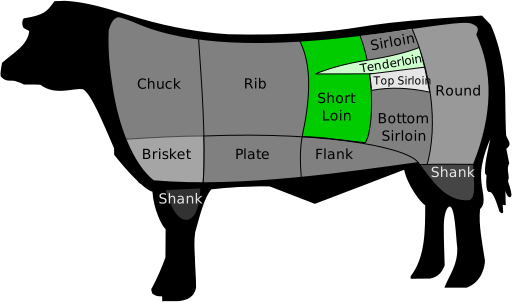
On four-legged animals the muscles of the neck, chest and legs support most of the animals weight. If you are a cow this is a lot of weight. Even just standing in a field these muscles will be working hard just holding up the animal.
Accordingly, if we are cooking steak we want to avoid these muscles, like the brisket, and go for the comparatively under-used muscles towards the rear and the top of the animal. The tenderloin, for example, has almost no connective tissue.
| Cut | Usage Level | Connective Tissue / Collagen | Best Cooking Method |
| Tenderloin / Filet | Extremely Low | Minimal | Quick Sear / High Heat |
| Ribeye / Sirloin | Low to Moderate | Moderate (High Marbling) | Pan-sear, Grill, Sous-vide |
| Rump / Flank | Moderate | Moderate to High | High Heat (sliced thin across grain) |
| Chuck / Brisket | Very High | Heavy Collagen Content | Low & Slow Braising / Smoking |
What Do We Want When We Cook Our Steak?
So, we’ve considered an animals anatomy and we’ve selected a tender cut of meat for our steak. There’s two things we want to do to cook it well. The first is to cook the inside of the steak to an appropriate level: rare, medium or, if you must, well done.
The second thing we want to do is get a good sear on our steak. We want a crust on our steak that is not only tasty but looks good as well.
Getting the Internal Temperature Right
If you haven’t read it already it might be worth having a look at my post on frying an egg. Because the aim of cooking a steak is exactly the same as when frying an egg. We want to coagulate our proteins using heat.
When we coagulate our steak proteins we ‘unwind’ them and cause them to form a network of tangled proteins. As the temperature increases the protein network contracts and forces water out of the steak.

Myosin, the most abundant muscle protein, unwinds and starts coagulating at around 50C so if we have a rare steak (~48C) we will basically be eating uncoagulated proteins. But, importantly, all the moisture will still be in the steak.
This is why anatomy is important in cooking a steak. We can get away with eating a rare tenderloin because it is tender, there isn’t much protein or connective tissue. If you try it with brisket you’ll be chewing for a long time.
A medium steak, at 60C, will have more coagulation and more moisture ‘squeezed’ out and a well-done steak (71C) will have most of the protein coagulated and interacting tightly with each other and a lot of the moisture gone, so dry and tough. Just like frying an egg.
| Target Doneness | Internal Temp (°C / °F) | Primary Protein Reaction | Texture & Moisture Impact |
| Rare | 48°C–52°C | Myosin begins unraveling | High moisture retained; soft texture |
| Medium-Rare | 53°C–57°C | Myosin fully coagulated | Ideal tenderness & juiciness balance |
| Medium | 58°C–62°C | Actin starts contracting | Muscle fibers squeeze out moisture |
| Well-Done | 68°C+ | Collagen breaks to gelatin (>70°C) | Dry & tough in tender cuts |
The Sear
The other part of the steak cookery puzzle is the sear on the steak. Often incorrectly called caramelisation, the sear on a steak is actually an example of the Maillard reactions.
The Maillard reactions are a form of browning that occurs when proteins react with sugars. I cover sugars in future posts, but for now it is enough to know that these reactions on the surface of the steak create many new, and poorly understood, compounds that are not only delicious but give the steak an attractive appearance.
The Maillard reactions don’t just occur on steak they are responsible for a lot of flavour in a lot of foods including bread, chocolate and roasted nuts, to name a few, and they are an important part of the beer and whisky making processes.
For a flavourful steak we really want to cause some Maillard reactions on the surface of our steak. The problem with this is that the Maillard reactions happen at well over 100C, most rapidly between 145C and 165C. This is well above the temperature that we want our steak to be at internally, say 54C if we want a medium rare steak.
Searing does not ‘lock in moisture’
Searing the steak does not seal in moisture, if it did we wouldn’t have to worry about drying out our steak, we could just sear it and cook it as long as we wanted. If you know anything about how gases expand when heated you’d also expect the steaks to swell when we cooked them instead of shrinking.
This piece of voodoo science is remarkably persistent, I’ve heard Michelin starred chefs telling people to ‘seal in the moisture’, on many cooking shows and I fly into a nerd rage every time.

Putting it All Together
So lets put all this together. We have a tender steak that we want to cook to medium rare with a nice sear. To achieve this we need to get the centre of our steak to around 54C. The problem is that we want the outside of the steak to get about 100C higher, to get our sear.
This is what makes grilling a tender cut of meat so challenging. Coals glow at around 1100C and gas burns at 1650C. Under these conditions we have a very steep temperature gradient that makes it difficult to control the internal temperature of the steak even if we achieve a good sear.
If we cook at much lower temperature the temperature gradient will be a lot shallower giving us more time to control our internal temperature but we wont get any searing on the steak.
We know that it’s possible to solve this seemingly intractable problem, we’ve all eaten a well-cooked steak. So how do people who can cook steak solve this problem?
Cook the Steak Sous Vide
Probably the most fool-proof way of cooking a steak. You vacuum seal your steak in a plastic bag and put in a temperature controlled water bath.
After the steak has been in the water bath for an hour or so, you take it out and attack with a blow-torch or sear it on a really hot pan.

It’s impossible to overcook a steak using this method because it’s impossible for the steak to exceed the temperature of the surrounding water. As long as you don’t stuff up the searing you’ll have a well cooked steak.
Th upside of this method is a perfectly done steak, the downside is that it’s a lot less fun standing around a water with a beer. It might be good for a dinner party but if you want serve steaks of different temperatures you’ll need multiple water baths.
Use High Heat and Low Heat
A strategy commonly utilised in restaurants is to quickly sear the steak over high temperature and then put it in the oven to finish at a lower temperature.
On the grill you can mimic this technique by setting up a two zone grilling zone, you arrange the coals or turn down gas elements, so that there is a hot part of the grill and a relatively cool part of the grill. Sear the steak on the hot part of the grill and then finish it off in the cool zone until your happy with the internal temperature.
Use Care and Attention on the Hob
You can cook a steak perfectly well using a single pan on the hob. Use something heavy and heat-retaining like a cast-iron pan. Start with a hot pan and turn down the heat once you are happy with the sear and continue cooking until you get to the internal temperature you want. Butter can help with the browning so towards the end add butter to the pan and start basting.
This method probably takes more practice to get right but a meat thermometer helps, as it does for the previous method. It also works best when you’ve got one or two steaks to cook, it might get a bit difficult if you’ve got a bunch of people to feed.
The Importance of Resting Your Steak
Once we have cooked the perfect steak there is one more absolutely essential step. The steak must be rested. It might be hard when guests are demanding to be fed or you haven’t eaten all day but do not serve that steak till it has rested.
We need to rest the steak because when you take it off the heat the proteins that we have coagulated are tight and excluding water. If you cut into the steak this water will just run out.
If you give the steak some time the coagulated proteins relax a bit, increasing the space between the proteins. This allows the steak to retain a bit more water, keeping the water in the steak not leaking all over your plate.
For a steak you can probably get away with 5-10 minutes resting but longer wont do any harm at all, use the time to get side dishes on the table.
Conclusion
So that’s it, we’re maybe a little better prepared to cook some good steaks for our friends and family. Even though it’s a long post I’ve still left out a lot. Things like salting your steak, making sure it’s dry, the different types of muscle tissue that give us light and dark meat, how to deal with tougher cuts of meat and a whole bunch of other things that we probably need to know.
So, I’ll be writing more about steak cookery. But I’m hoping this is a good enough start to let us stand a little taller at BBQ time and be able to honestly say that we don’t suck at cooking steak.
Cooking Steak FAQ
What is the Maillard reaction in steak cooking?
The Maillard reaction is a chemical reaction between amino acids (proteins) and reducing sugars that occurs when meat reaches temperatures between 145°C–165°C. It produces hundreds of new flavour compounds and gives steak its rich brown crust.
Does searing a steak lock in juices?
No, searing does not lock in juices or form a waterproof seal. Moisture is lost primarily as muscle proteins contract under heat. Searing is done purely to create complex savory flavours through the Maillard reaction.
Why is resting steak important?
Resting allows muscle fibers that tightened during cooking to relax as the internal temperature stabilizes. This relaxes the protein structure, enabling the meat to retain juices rather than spilling them onto the cutting board.
Why are some cuts of meat tougher than others?
Toughness is determined by muscle usage and collagen content. Heavily exercised muscles (like brisket or shoulder) develop thick muscle fibers and abundant connective tissue, whereas underworked back muscles (like tenderloin or ribeye) remain tender with low collagen.
Leave a Reply