

One day, years ago, when I was a cocksure university undergraduate, I was chatting to some Jehovah’s Witnesses who had come to the door of the share house I lived in. We discussed a few things but at one point the guy I was talking to said that when it came to evolution he didn’t understand how, if you threw someone in a pool they would grow gills. With all my freshly gained undergraduate knowledge, I was happy to explain that this wasn’t how evolution worked. That evolutionary change happened over aeons as random mutations made individuals better or more poorly adapted to their local environment1. That, if you threw some people of both sexes in a very large pool and came back in a million years you might have dolphins. I don’t think he really got it; I certainly didn’t explain it very well.
The incident has always stuck in my mind though. Mainly it’s the embarrassing memory of what a little prig I was but also because it reflects one of the early, and most serious, of the criticisms of Darwin’s theory. Darwin’s proposition was that new species arose gradually over time. Darwin’s problem was that he had no mechanism of inheritance that could support his claims, he had absolutely no idea about genes or genetics, and the existence of intermediate species was not well supported in the fossil record. Something like the Cambrian explosion2 actually seemed to show the opposite with the sudden appearance of many new species over a, relatively, short period of time.

The lack of a clear mechanism for inheritance was a big problem for Darwin. When he, and Alfred Russel Wallace, announced their theory of evolution by natural selection in 1858 they had sparked a fierce controversy. A controversy that would last for decades. Many parts of society were implacably opposed to evolution and, far from being an esoteric academic fight, the truth of Darwin’s theory engaged almost all levels of Victorian society. As the debate raged, Darwin’s inability to explain how organisms pass traits to their offspring provided plenty of ambiguity for those seeking holes in his theory. One of the main criticisms was the lack of “missing links” in the fossil record. Darwin badly needed a mechanism, and some fossils, to really establish his theory.

Given the importance of inheritance to the theory of evolution, it is amazing that, for almost the whole time Darwin was fighting to defend his theory, a mechanism was just sitting there in an obscure journal, waiting to be discovered. An Austrian monk called Gregor Mendel had published what was going to become the basis of modern genetics in 1866. His theories provided the mechanism the Darwin so sorely needed, but absolutely no one saw or realised the importance of his work.
Mendel, working with pea plants in a monastery in the Moravian town of Brunn (now Brno in the Czech Republic), had worked out that heritable traits were passed down in discrete units, one from each parent, as well as the principles of dominance and independent assortment (see the post on bananas for a genetics refresher if you need it). But it wasn’t until the early 1900s (long after Darwin’s death in 1882) that Mendel’s work was discovered and he became the “father of genetics”.

In the meantime, with Mendel’s work languishing in obscurity, there were plenty of other theories competing with Darwin’s version of evolution. One of the biggest rivals was something called Lamarckism, named after a French scientist Jean-Baptiste Lamarck3. One of the key aspects of Lamarckism is that attributes that organisms acquire during their lifetime can be passed on to their offspring.
A blacksmith, for example, could pass down a predisposition for strength to his offspring because of the muscular development he, or she, had acquired from long hours working at the anvil. In Lamarckism the emphasis is on individuals developing traits that made them better adapted to their environment. Traits that could then be passed onto their offspring. The Lamarckist view of evolution was a progression of continual improvements as organisms adapted to their environment.
For this reason, as an alternative to Darwinism, Lamarckism was very popular in Victorian society. It didn’t dethrone man as the pinnacle of creation. Darwinism, driven as it was by random mutations that were filtered by natural selection, implied that evolution could end up anywhere and that, gasp, humans were not the inevitable perfect endpoint of evolution.
Lamarckism with its continual improvement gave a direction and an endpoint to evolution; that endpoint being us. To many Victorians we were created in the image of God, we weren’t just the descendent of some monkey who got a couple of lucky mutations. Lamarckism also gave some agency to our own evolution, if we changed ourselves we could change our offspring and we could do the same to other species. More prosaically, it also gave a scientific explanation for things like nepo-babies and the class system. Under Lamarckism, aristocratic families are aristocratic because they pass on their acquired virtues to their offspring4.

Nonetheless, despite it’s attractions, by the 1920’s Lamarckism was well and truly on it’s way out of fashion. Mendel’s work had finally been discovered and first bricks in the edifice of modern genetics had been laid. The new dogma was that only DNA from our germ cells, the cells that develop into sperm and eggs, is transmitted to the next generation and that anything that happens to the other cells in our body, our somatic cells, cannot be passed on to our offspring. You could lift all the weights in the world but nothing you do to your pecs is going to be reflected in your offspring. There is just no mechanism for the transference of genetic information that would enable this in Mendelian genetics.
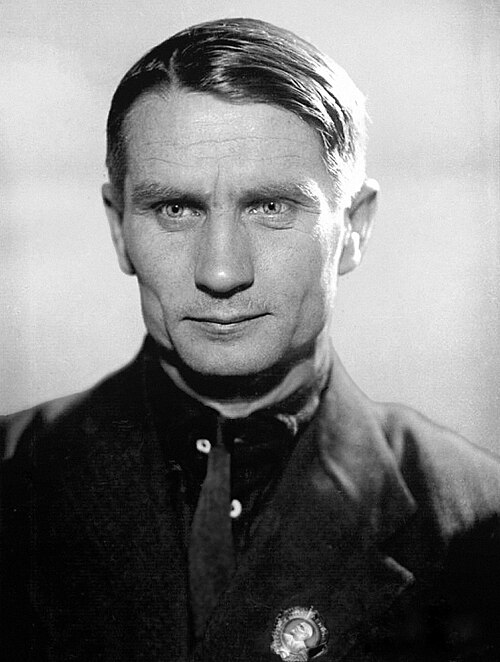
So another victory for the scientific method? Lamarckism consigned to the dustbin of history never to be heard of again? Well, not quite. As we’ll find out later Lamarckism has made something of a comeback recently. But, before this, even as it was being discredited by modern genetics and, frankly, becoming something of a joke, Larmarckism found a place were it could make one last bid for scientific legitimacy. In the USSR, under the influence of an Ukranian scientist called Trofim Lysenko, a modified form of Larmarkism became the state sponsored theory of evolution for the Soviet state.
Lysenko had been born into a Ukrainian peasant family but had worked his way through school and university and become a leading agronomist5 in the pre-WWII Soviet republic. Agronomist was a reasonably important job in the USSR at this time. Some disastrous politically-motivated experiments in collectivist reforms had caused food production in the USSR to dip precipitately. By 1930 Soviet agriculture was in crisis, people were starving and there was an urgent need to increase food production. In this environment, Lysenko, who worked on practical methods to increase crop yields, started getting some attention from his political bosses.
One of these bosses was the biggest possible boss: Josef Stalin. Russia is a cold, cold place and the promise of being able to increase agricultural production in cold areas not currently contributing to the agricultural output of the union was an attractive proposition for Uncle Jo. One of the things that really caught his attention was Lysenko’s insistence that he could quickly turn winter wheat varieties into spring wheat varieties using a process he called “vernalization”.
Vernalisation relies on the fact that wheat can be differentiated into two varieties that differ by when they are planted and when they are harvested. Spring wheat varieties are planted in spring and harvested in late summer or early fall. It is fast growing; it is planted and harvested over the course of a single spring and summer. Winter wheat, on the other hand, is planted in fall, it experiences cold winter conditions that cause it to germinate but then it enters a period of dormancy. The following spring it flowers and it is harvested in the summer. Winter wheat takes a lot longer to grow but it has some resistance to the cold. In fact the cold is necessary, without it the winter wheat wont flower in spring.
In the extremely cold parts of the USSR the problem is that even winter wheat couldn’t last through the winter but the window between spring and summer was too short to allow spring wheat to grow either. Lysenko promised to correct this by transforming winter wheat into spring wheat using his version of vernalization. This way he would have a cold resistant wheat that could grow quickly like a spring wheat.
The combination of faster growth and cold resistance meant that vernalised winter wheat could be grown in very cold areas because it could be planted in spring and harvested in late summer. Importantly, Lysenko claimed that plants that he vernalised could pass their acquired abilities to their offspring, that he could transform winter wheat to spring wheat and vice versa. We’ve heard this before of course, it’s Lamarckism.
Lysenko’s promise of increased agricultural yield, his endorsement of Lamarckism, which was also favoured by communist theory, and his enthusiastic Leninism made him a successful man. He was given his own laboratory at the Breeding and Genetics Institute in Odessa in 1929, in 1938 he became president of the All-Union Academy of Agricultural Sciences and in 1940 he became the director of Genetics for the Academy of Sciences. In 1948, Lysenkoism, with the full and active support of Joseph Stalin, was proclaimed as the only acceptable theory of genetics in the USSR.
Lysenko’s primacy was associated with an extreme politicisation of science, he denied the existence of genes, calling them a “bourgeois invention”, and condemned the developing field of genetics as “fascist science”. He condemned scientific oppenents as anti-Marxist and reactionary saboteurs. Although not on his direct order, scientists who didn’t conform to his body of theories, that came to be called Lysenkoism, were regularly arrested, often imprisoned and sometimes shot.

Lysenko had won the political battle but he was living on borrowed time. You can only fly in the face of reality for so long. You can shoot dissenting humans but plants won’t do what they can’t do. Lysenko never produced any real evidence that he could turn winter wheat into spring wheat. It turns out you can’t harangue a plant into compliance, you can’t imprison a plant until they behave and you can’t shoot some plants as an example to the other plants.
Lysenko’s science failed and it contributed to the death of millions of Russians in the famines of 1930-1933 and 1946-1947. Some of his practices were adopted by Communist China, including vernalization, and another 15 to 55 million people died there between 1959 and 1962. All this occurred while agriculture in the West was undergoing a revolution, thanks to Mendelian genetics, that bought about increased crop yields and the development of new varieties resistant to pests and diseases. In the Soviet Union, by using political rhetoric and state-backed violence to face down his scientific opponents, Lysenko destroyed the fields of genetics, biology and agronomy.
It’s not hard to draw some parallels with Lysenkoism and some of the things going on in the world today. Clearly science is being politicised in the USA under the Trump administration. Just one example, among many, is the spectacle of Robert Kennedy, a Health Secretary with zero scientific or medical qualifications, declaring that autism is caused by Tylenol on the basis of very limited scientific evidence. Lysenkoism had some grave consequences for the USSR, what will be the consequences if we go down the same path now? Climate change, vaccines, COVID-19, nutrition, and many others, are all issues where misinformation, profit making, private agendas and magnification of doubt seem to play a greater role in the debate than scientific evidence.
Lysenko was not some lone voice preaching in the wilderness, he held absolute control over Soviet genetics for close to 20 years and he still could not experimentally validate his theories or put them into practical use in the agriculture of the USSR. The consequence of these failures wasn’t just some embarrassment in the faculty staff room, these failures had very real and immediate consequences for millions of people. Lysenkoism, today, is a crystal clear example of what happens when we forget that science, for better or for worse, is the base on which we have built our modern societies. Science isn’t esoteric and it isn’t just something that scientists argue about at conferences. Without science we would be unable to support the large and incredibly complex societies that science has allowed us to create. If we now start subverting science to our whims, desires and illusions, like Lysenko did, we are going to come into some very bad times indeed.
Footnotes
- A massive simplification of the field of genetics and evolutionary biology but I was an undergraduate. ↩︎
- The Cambrian Explosion was the sudden massive increase in the number of complex animal life that occurred in the Cambrian period, some 540 million years ago. During this time almost all the animal groups (or phyla) that we see today made their first appearance. It should be noted that when a palaeontologist says ‘sudden’ they mean something different from the rest of us. The Cambrian explosion went on for somewhere inbetween 13 and 25 million years, so it wasn’t quite overnight. ↩︎
- Given that Lamarckism is often held up for ridicule these days it is a a bit of a shame the Lamarck got lumbered with the dubious honour of naming the theory. He didn’t really propose it, he just referred to it as it was a common way of thinking about heredity at the time. See here if you’re interested in his story. ↩︎
- Something that even a cursory reading of history soon disproves. ↩︎
- Agronomy is the science of soil management and crop production. ↩︎


 The Science of Food


Leave a comment